Revving up to build: Top Down with Matt Nowzari
Inside a software engineer’s builds at Elastic
.png)

 Share on Twitter
Share on Twitter

 Share on LinkedIn
Share on LinkedIn

 Share on Facebook
Share on Facebook

 Share by Email
Share by Email

 Print this page
Print
Based in North Carolina, Matt Nowzari is a software engineer on Elastic’s Search team, shaping how external data flows into Elasticsearch. His work spans tools like Open Crawler, Elastic connectors, and Agent Builder.
Matt is drawn to high performance and community, which is clear in his love for autocross and open source.
“We're open source by nature with a lot of our products, which is really quite amazing. Open source is definitely the way forward, and we've been able to establish community at Elastic and the wider developer community.”
Matt believes that engagement drives innovation. “It’s important that developers interact with us because we are open source,” he says. It’s how the community moves forward. “If you’re a developer, tinker around, open a pull request or ticket, don’t be afraid of the code that runs the product, and get technical with it.”
Outside of engineering, his passion is cars. He races in autocross events, volunteers with a local car club, and is working toward becoming a certified track instructor.
Whether he’s refining search pipelines, experimenting with AI, or racing, the approach is always the same: stay curious, stay critical, and keep building.
Here is how Matt Nowzari gets ready to build.
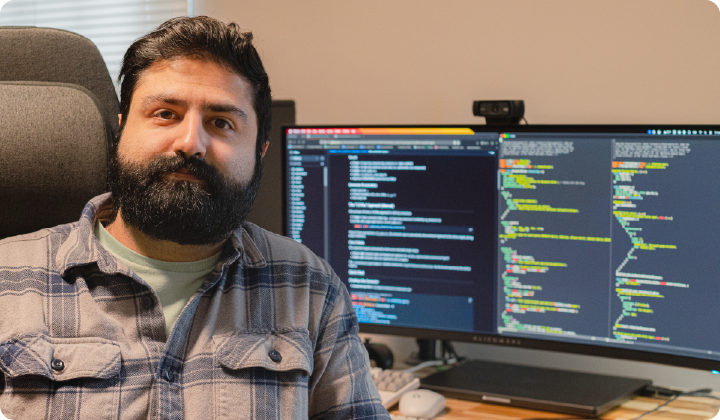
How do you get your space ready to build?
Matt’s workspace has to get him ready to debug code and come up with creative solutions. Before he sits down to work, Matt starts his day with his own community: his family. He takes a walk with his dog and has breakfast with his wife before logging on.
Matt has optimized his schedule to make the most of his days. Mornings are often spent syncing with European teammates, followed by meetings that taper off in the afternoon. Matt enjoys this opportunity for face time and connection early in the day. “Communication is something that I am good at. I enjoy being able to connect with my coworkers,” he says of his proactive and personal approach to work, “and my manager and my coworkers really appreciate that I do that.”
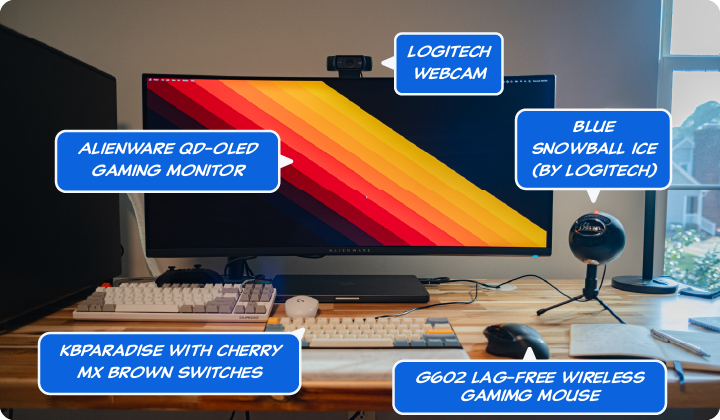
In the afternoon, Matt protects his deep-work time. That’s when real progress happens. Working for hours on end at his desk, his workspace is designed for focus and flexibility. His trusty MacBook Pro (standard across his team) has pride of place at the center of his Uplift standing desk.
An Alienware QD-OLED ultrawide monitor dominates the desk, chosen for its vibrant colors and versatility for both work and PC gaming. His favorite desk item, though, is far simpler: a Cherry MX Brown mechanical keyboard he’s owned since graduating from university. “I like the tactile feeling,” he says, “But it's not overly loud. My wife works from home, so I don't drive her crazy with loud clicking and clacking all day long.”
Though Matt takes most of his meetings on his feet, he recently invested in a Fractal Refine chair to keep long coding sessions comfortable.
“I always rolled my eyes at ergonomics, but once I turned 30, it all of a sudden made sense,” says Matt. “Being able to actually sit comfortably at a desk reduces stress on your body physically, because otherwise, you're just gonna get up off the computer at 5:00 p.m. and be in pain.”
When it comes to tools, VS Code is his daily driver, with Cursor becoming a newer addition to his workflow. He uses it primarily as a critical sounding board, asking prompts like, "A junior engineer wrote this code. Are they making good use of the idioms and patterns in the existing code base?" The goal isn’t to replace his judgment, but to sharpen it.
“I’ve found that AI is useful for double-checking code, double-checking your thought process, being a sounding board, and being hypercritical.”
When it’s time to lock in, he reaches for UK drum & bass or UK garage playlists. The repetition helps his brain settle into a rhythm, turning hours of heads-down work into a steady, focused flow.
You’re ready to build. What are you building?
At its core, Matt’s work is about transformation, making complex data searchable and usable to help users bring their data to life.
One of the most exciting shifts he’s seen since joining Elastic is the rise of Agent Builder in Kibana. The idea that you can have a natural conversation with your data wasn’t even on his radar a year ago, and now it’s a core part of how users interact with Elasticsearch.
If time weren’t a constraint, he already knows what he’d build next: a searchable knowledge base for older cars. Valuable repair information is often buried in decades-old forum posts that modern search tends to overlook. His idea is to ingest that long-term knowledge into Elasticsearch and use Agent Builder to surface insights that would otherwise be lost to time.
For Matt, learning Elasticsearch followed the same philosophy: start with the basics, then learn by doing. From engineering school to hands-on experimentation, curiosity and iteration have been the fastest path to growth.
Inspired by how Matt builds? See open roles at Elastic and find where your curiosity can turn into real-world impact.
All trademarks, registered trademarks, product names, company names, and/or logos mentioned or otherwise displayed herein are the property of their respective owners, and use of these marks does not imply endorsement by or affiliation with their owners.
Share
- Share on Twitter
Share on Twitter
- Share on LinkedIn
Share on LinkedIn
- Share on Facebook
Share on Facebook
- Share by Email
Share by Email
- Print this page
Print