Elastic named a Leader in the IDC MarketScape: Worldwide Observability Platforms 2025 Vendor Assessment

 Share on Twitter
Share on Twitter

 Share on LinkedIn
Share on LinkedIn

 Share on Facebook
Share on Facebook

 Share by Email
Share by Email

 Print this page
Print
We're proud to share that Elastic has been named a Leader in the IDC MarketScape: Worldwide Observability Platforms 2025 Vendor Assessment (doc #US53004325, November 2025). We believe this recognition validates our ongoing mission: to deliver an observability platform that is open, extensible, and AI-driven to power full-stack observability that unifies operational and business data at scale, allowing SRE teams to move from detect and resolve problems faster.
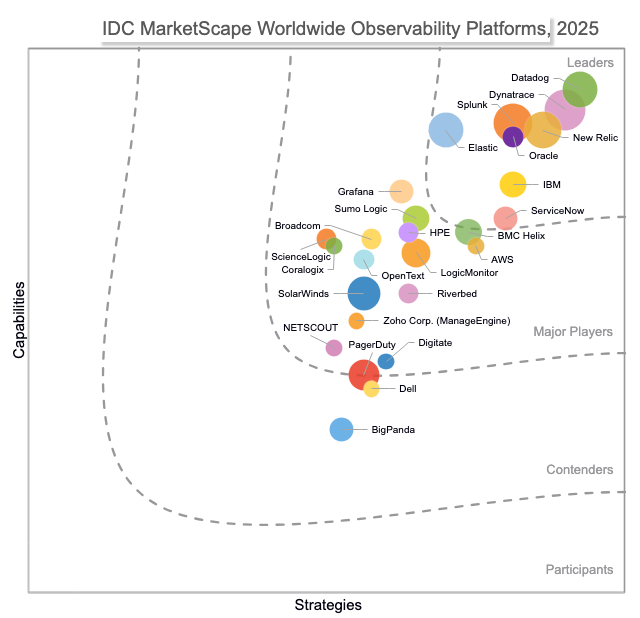
Why we believe the IDC MarketScape recognized Elastic as a Leader in observability
IDC highlights several strengths that set Elastic apart, including:
Open-standards-first architecture: Elastic ingests OpenTelemetry (OTel) natively via OpenTelemetry protocol (OTLP). Elastic Distributions of OpenTelemetry (EDOT), a fully open distribution of the OTel collector and language SDKs, provides SREs and developers with a stable, production-tested OTel ecosystem backed by enterprise-grade support.
Scalable architecture: Elastic Cloud processes petabytes of telemetry daily across 50+ regions. Elastic’s scalable stateless architecture offers high-performance, cost-efficient storage with optimized compression for a smaller footprint.
Business-aware observability: Elastic contextualizes technical performance with customer experience and business metrics out of the box by correlating backend traces with Real User Monitoring (RUM) for web and mobile and connecting to Core Web Vitals and other frontend metrics, making impact analysis direct and intuitive during triage and prioritization. Unstructured business data can be ingested alongside observability telemetry, enriched through custom attributes on traces and logs, and visualized in dashboards to quantify how latency or errors influence conversion, revenue, or other business KPIs without leaving the unified analytics surface.
Data governance and compliance: Centralized audit logging, role-based access controls, and unified policy enforcement ensure teams can collaborate on observability data while maintaining security, accountability, and regulatory compliance across the organization.
As IDC observed, Elastic helps enterprises balance fidelity, cost, and value by making observability open, scalable, and business-centric.
Advancing observability with Streams
With the introduction of Streams, we're redefining observability. With Streams, SREs no longer need to spend time wrangling data before they can be investigators. Logs are the primary investigation signals because Streams provides SREs with the ability to:
Log everything in any format and stop worrying about pipelines: Stop wasting time building and maintaining complex ingestion pipelines. Send logs in any format, structured or unstructured, from any source directly to a single Elastic endpoint without needing specific agents. Use OpenTelemetry collectors or any other data shipper to send logs to Elastic. Streams’ AI-driven processing parses and structures your log data, making it immediately ready for investigation. This means you can adapt to new log formats on the fly without the need to maintain brittle configurations. Streams ensures you always have the data you need at the moment you need it.
Not only collect logs but also get answers from them: Streams analyzes your data to surface “Significant Events,” proactively identifying critical errors, anomalies, and performance bottlenecks like out-of-memory exceptions. Instead of manually sifting through terabytes of data, you get a clear, prioritized starting point for your investigation. This allows you to go from symptom to solution in minutes, fixing issues before they impact users.
Achieve complete visibility at a lower cost: Get comprehensive visibility across all your services without the expected expense. By intelligently structuring data and surfacing only the most critical events, Streams reduces operational complexity and dramatically cuts down root cause analysis time. This efficiency allows you to store all relevant log data cost-effectively, ensuring you never have to sacrifice crucial visibility to meet a budget. Get clearer answers faster and lower your total cost of ownership.
Streams revolutionizes observability by transforming logs from a noisy and expensive data source into a primary investigation signal. Through AI-powered capabilities like automatic partitioning, parsing, retention management, and the surfacing of Significant Events, Streams empowers SREs to move beyond data management and directly pinpoints the root cause of issues. By reducing operational complexity, lowering storage costs, and providing complete visibility, Streams ensures that logs, enriched by AI, become the fastest path to resolution by answering the why? for observability.
Continuous innovation with Elastic
A core differentiator of Elastic is our relentless commitment to innovation in observability. We're constantly pushing boundaries and developing capabilities that transform how teams monitor, analyze, and optimize their systems. Here are some Elastic innovations over the last year:
Streams: A rethinking of how observability is done by organizing and finding meaning and problems in your data automatically with AI
Elastic AI Assistant: Fully agentic and retrieval augmented generation (RAG)-based using your own GitHub repos and Wikis for specific and relevant troubleshooting and remediation insights
EDOT: A fully scalable and supported OTel distribution
Elastic Cloud Serverless: A new completely stateless storage architecture
LLM observability: To understand if your models are performing optimally and hallucination-free
Elasticsearch logsdb index mode: Saving up to 70% of log storage costs
Elastic Agent Builder: Build your own AI Agents to use observability data for your domain-specific use cases, and empower enterprise large language models (LLMs) via model context protocol (MCP).
- Universal Profiling: Donated to the OpenTelemetry project for lightweight code-level profiling
We don't just ship innovations like those above; we also share our thinking. Elastic Observability Labs is a dedicated space where we expose our technical decisions, experiments, and early innovations through transparent development and active community engagement. It's working ideas, engineering stories, and lessons learned as we build. We help customers and practitioners see what's next by providing:
Insider views on how the OpenTelemetry project is stewarded and evolving
Guidance on bridging between log data and OTel context, making observability more holistic
Features like Elastic’s Managed OTLP endpoint — a serverless, scalable ingestion path offering native OTLP support, reducing the barrier to instrumentation
Capabilities like Logs Essentials that lets users ingest, store, and query logs without the overhead of managing infrastructure
- Technical previews like ES|QL LOOKUP JOIN that lets users enrich logs with metrics and traces dynamically — no need to denormalize at ingest time
The Elastic difference
Elastic delivers a unified AI-powered platform that brings together observability, security, and search so that organizations can detect, analyze, and act on relevance across all their data in real time. Within observability, Elastic’s differentiated approach is grounded in being:
Open and extensible: OTel-first and Prometheus-compatible ensures interoperability across diverse environments.
Scalable without limits: A stateless SaaS architecture that decouples compute from storage and indexing from search that scales seamlessly. Using cost-effective, cloud-native object storage while retaining Elasticsearch’s fast low-latency querying.
Native in AI and relevance: Elastic AI Assistant answers natural language questions using your internal knowledge like runbooks and past incidents. Our Elastic Inference Service (EIS) provides the relevance models. Combined with ES|QL and machine learning, it helps your team pivot from what happened to why it happened and how to fix it.
We're honored to be named a Leader in the IDC MarketScape. We believe the recognition underscores our continued investment in reimagining observability through AI-driven innovation like Elastic Streams, Agent Builder, and AI Assistant. Our mission is to help every team move from reactive troubleshooting to proactive, intelligent operations that keep their digital experiences fast, reliable, and resilient.
Santosh Krishnan, General Manager of Security and Observability, Elastic
Read the excerpt
For more information, read our IDC MarketScape Worldwide Observability Platforms 2025 Vendor Assessment excerpt, and start your Elastic Cloud free trial.
IDC MarketScape vendor analysis model is designed to provide an overview of the competitive fitness of technology and suppliers in a given market. The research methodology utilizes a rigorous scoring methodology based on both qualitative and quantitative criteria that results in a single graphical illustration of each supplier's position within a given market. The Capabilities score measures supplier product, go-to-market and business execution in the short-term. The Strategy score measures alignment of supplier strategies with customer requirements in a 3-5-year timeframe. Supplier market share is represented by the size of the icons.
The release and timing of any features or functionality described in this post remain at Elastic's sole discretion. Any features or functionality not currently available may not be delivered on time or at all.
In this blog post, we may have used or referred to third party generative AI tools, which are owned and operated by their respective owners. Elastic does not have any control over the third party tools and we have no responsibility or liability for their content, operation or use, nor for any loss or damage that may arise from your use of such tools. Please exercise caution when using AI tools with personal, sensitive or confidential information. Any data you submit may be used for AI training or other purposes. There is no guarantee that information you provide will be kept secure or confidential. You should familiarize yourself with the privacy practices and terms of use of any generative AI tools prior to use.
Elastic, Elasticsearch, and associated marks are trademarks, logos or registered trademarks of Elasticsearch N.V. in the United States and other countries. All other company and product names are trademarks, logos or registered trademarks of their respective owners.
Share
- Share on Twitter
Share on Twitter
- Share on LinkedIn
Share on LinkedIn
- Share on Facebook
Share on Facebook
- Share by Email
Share by Email
- Print this page
Print