Advanced vector search in air-gapped environments
_(1).png)

 Share on Twitter
Share on Twitter

 Share on LinkedIn
Share on LinkedIn

 Share on Facebook
Share on Facebook

 Share by Email
Share by Email

 Print this page
Print
For organizations in air-gapped environments with no external network connection, implementing the latest search and AI technology can be challenging, often to the point of impossibility. However, Elastic’s customers in highly sensitive industries, such as national security and defense, have relied on Elastic’s agile technology for over a decade, trusting it for mission-critical use cases in air-gapped environments or even on tech kits. Let’s take a closer look at what this looks like for a use case, such as multimodal vector search.
As AI becomes more embedded in organizations’ day-to-day operations, it’s never been more critical to have the ability to surface relevant, contextual information from a vast sea of data — both structured and unstructured. Without the ability to query and analyze all data types holistically, the effective use of generative and agentic AI is limited. Frequent data challenges in public sector include:
Lack of developers: While generative AI (GenAI) tools may be readily available, organizations may lack the technical expertise needed to implement them effectively.
- High data volume: Public sector organizations face unprecedented amounts of data, much of which is subject to intense regulations or classification levels.
- Data isn’t always ready for AI: Critical information is often stored in formats like PDFs, diagrams, and videos, making it difficult to extract relevant insights.
RAG: An efficient data retrieval model for AI
Many public sector organizations are finding it difficult to train or even fine-tune large language models (LLMs) for the kinds of queries their employees and stakeholders are conducting. They want to use their proprietary data out of the box with AI even when that data is complex or disconnected.
Retrieval augmented generation (RAG) is a scalable solution that addresses larger challenges around limited time and resources as well as the need to process vast amounts of structured and unstructured data. In Elastic’s RAG model, before a user’s question is submitted to an LLM, it first queries our vector database, which can surface relevant context from an organization’s proprietary data via vector search. This step, or context layer, significantly reduces the data universe that an LLM relies on for its output. Agentic AI evolves this model further; a query interacts with AI agents that can perform multiple subqueries and act as an intermediary between the user and the LLM.
Multistage retrieval and multimodal search for complex data types
Along those lines, multimodal search use cases are rapidly expanding as organizations seek more intuitive and powerful ways to retrieve information across diverse data types. By combining text, image, audio, and video inputs, multimodal search allows users to interact with systems in more natural and meaningful ways. There are several compelling use cases for this in the public sector, as a wealth of knowledge is often stored in extremely long and dense PDFs and video recordings. The ability to search through these simultaneously is an invaluable resource that improves how quickly and accurately teams can find answers.
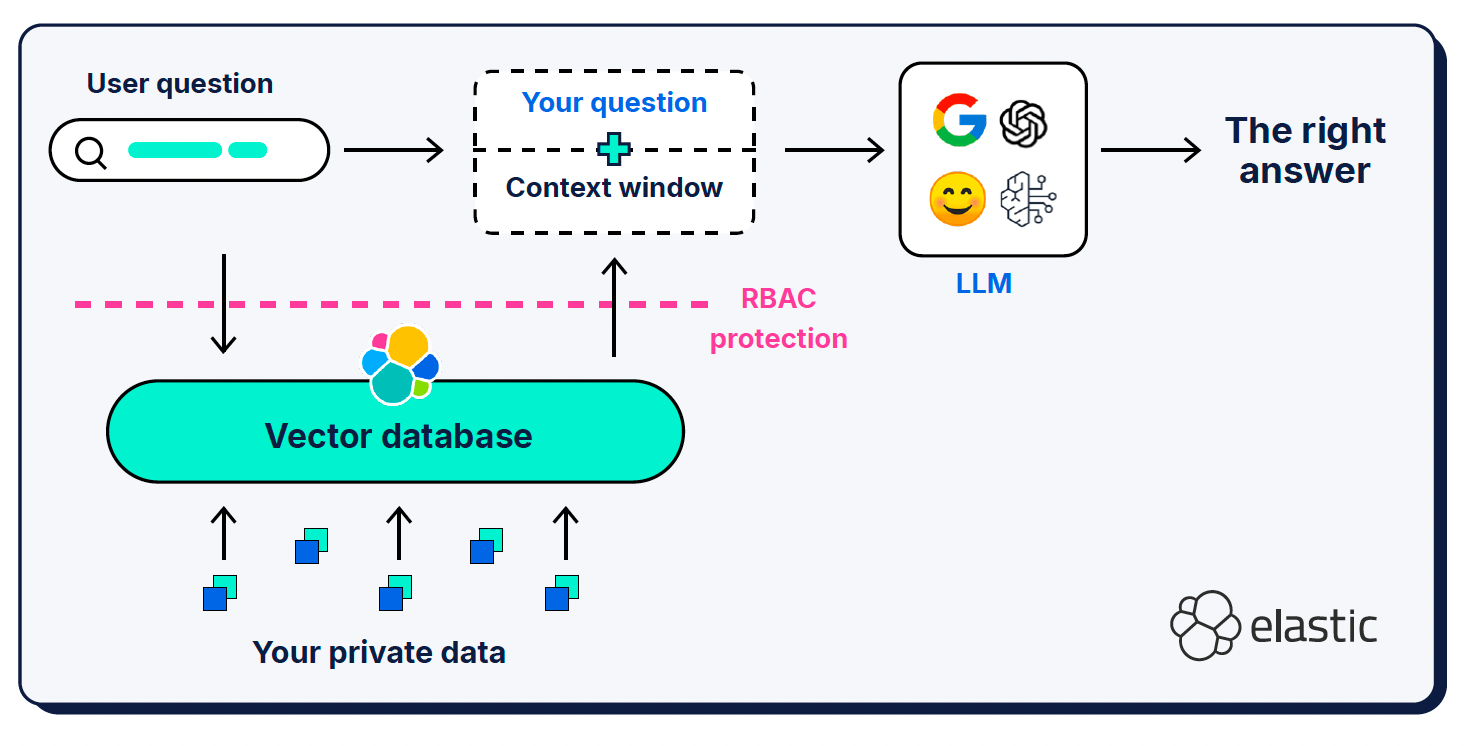
Elastic also uses hybrid search, which combines keyword search elements with vector search, as the foundation for multistage retrieval. This enables the system to rescore, rerank, and even apply personalization to find the exact video or PDF the user needs to answer their question. This approach recognizes that different technologies are required for approximate results versus highly specific results, allowing Elastic to deliver an extremely tailored dataset.
What does this look like?
For examples and more information on enabling advanced vector and multimodal search for air-gapped environments, watch our webinar, or download the white paper.
The release and timing of any features or functionality described in this post remain at Elastic's sole discretion. Any features or functionality not currently available may not be delivered on time or at all.
In this blog post, we may have used or referred to third party generative AI tools, which are owned and operated by their respective owners. Elastic does not have any control over the third party tools and we have no responsibility or liability for their content, operation or use, nor for any loss or damage that may arise from your use of such tools. Please exercise caution when using AI tools with personal, sensitive or confidential information. Any data you submit may be used for AI training or other purposes. There is no guarantee that information you provide will be kept secure or confidential. You should familiarize yourself with the privacy practices and terms of use of any generative AI tools prior to use.
Elastic, Elasticsearch, and associated marks are trademarks, logos or registered trademarks of Elasticsearch B.V. in the United States and other countries. All other company and product names are trademarks, logos or registered trademarks of their respective owners.
Share
- Share on Twitter
Share on Twitter
- Share on LinkedIn
Share on LinkedIn
- Share on Facebook
Share on Facebook
- Share by Email
Share by Email
- Print this page
Print